
The Email at 3 AM That Changed Everything
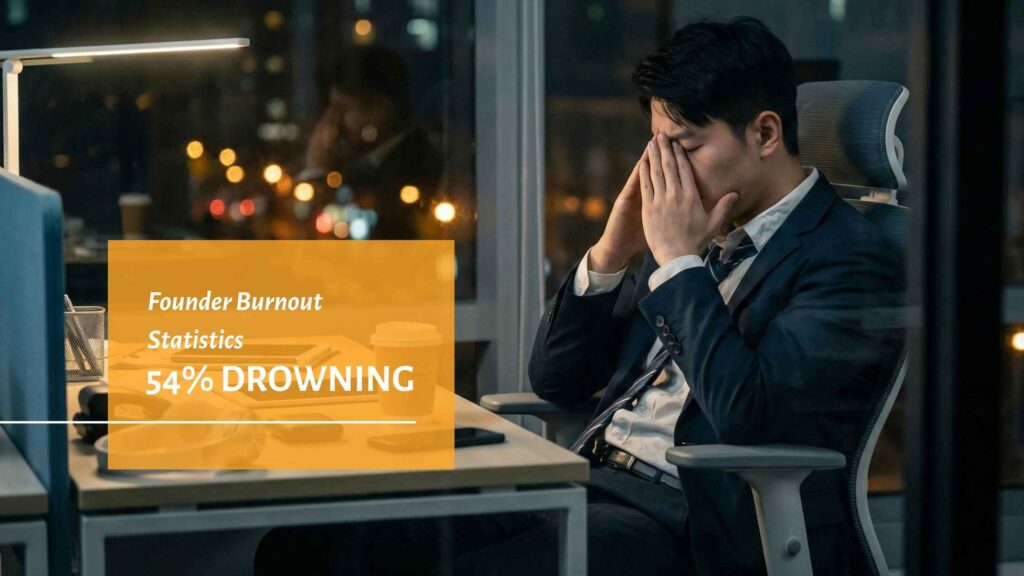
‘It’s 3 AM. You know you should be sleeping, but you can’t stop looking at your phone because you have a Slack message from your team, an email from a customer marked urgent, and a nagging worry about payroll. Your body is really tired. Your mind won’t quit working. You drank three cups of coffee since 6 AM yesterday, and to be honest, you can’t remember the last time you had a whole day off.’ You’re not alone if you relate to this. Founder burnout statistics show a worrying truth: 54% of founders are currently very stressed or burned out. And here’s the thing that makes it much harder: most of them don’t know they’re in trouble until they’re already in trouble.
The worst part? You could think that being burned out means you’re doing something wrong. No, you’re not. The system doesn’t work. Most founders think they’re giving 110% of their time and energy, but they’re really only working at 30% of their full potential. That space between what you’re giving and what you can give? That’s the trap that leads to burnout. And this tutorial tells you exactly how to get out of it.
Founder Burnout Statistics: The Important Numbers
Let’s talk about the stats, since they don’t lie. Founder burnout statistics give a scary picture of what’s going on in the startup sector right now.
54% of entrepreneurs are now tired. But if that sounds horrible, just wait till you see what’s really going on. The effect on mental health is huge: 72% of founders say their work makes them anxious and depressed. And that’s not even talking about the physical toll: 55% of entrepreneurs say they have trouble sleeping.
This is what keeps most founders up at night: 74% say their business obligations leave them with almost no time for self-care. That’s not a coincidence. This is due to our tendency to glorify overworking as founders. As a result, 62% of entrepreneurs have taken fewer vacations than they would like, and 64% spend significantly less time with family and friends.
The study delves considerably deeper. 87% of entrepreneurs throughout the world say they have anxiety, depression, or burnout. This is much higher than the overall population. 68% of founders are also suffering with chronic financial insecurity, not knowing if they can even pay their employees or cover their own bills.
The numbers on founder burnout aren’t simply numbers. They’re signs that we need to modify the way we run startups at a basic level.
The Real Reasons Why 54% of Founders Are Drowning
To know why founder burnout arises, you need to know the numbers. It’s not usually because of working too hard. It’s about working in the wrong places and not getting things done.
The culprit?
Most founders act like they’re still running a small company when they’re really scaling a big business. It sounds like you’re attempting to be a hero in the hustling culture by doing everything yourself. It really does sound like operational suicide.
Here’s the catch:
You have to do everything when you first start. You write code, sell things, keep track of your money, and respond to customer service emails at 11 PM. That’s how things are in the early days of a startup. But when sales reach between 1 Cr and 2 Cr, this method becomes the item that kills founder burnout numbers instead of beating them.
You keep hoping that the next person you hire will make things better. It will be fixed in the next system. The next update to the product will provide you some space. But every statistic about founder burnout shows that founders aren’t having a hard time because they’re lacking something; they’re having a hard time because they haven’t changed the way they operate.
Most business founders work between 60 and 100 hours a week. But here’s the harsh truth about research on productivity: After 55 hours a week, production doesn’t go up. It falls apart. People who work 70 hours a week get about the same amount of work done as people who work 55 hours a week. You’re not really getting more done. You’re only hurting your health in the process.
The bigger problem?
Money problems make everything worse. When 68% of founders don’t know how to pay their staff or themselves, every email, every lost customer, and every choice feels like it could change their lives. That’s not passion-based burnout; that’s fear-based burnout.
The 70% Capacity Problem: What It Is and Why You’re Not Seeing It
This is where founder burnout statistics become more useful. Most founders aren’t using 70% of their full potential. This is what that implies in real life.
Think about a factory that is only working at 70% of its full capability. What about that 30% that isn’t used? It means losing hundreds of thousands of dollars in sales each year. You are also subject to the same rationale. If you’re a founder producing ₹1–2 Cr in sales but only using 30% of your capacity, you’re losing ₹70 L–₹1.4 Cr every year. Not in money that will come in the future. Right now.
The 70% capacity that’s missing isn’t because of laziness. It’s not because they didn’t try hard enough. It’s because your priorities are out of whack, you’re not delegating well, your processes are dysfunctional, and yes, burnout is making it harder for you to make good decisions.
Here’s how the numbers on founder burnout show this: Founders who are anxious, depressed, or extremely stressed always do worse in three areas: strategic thinking, team scaling, and financial optimization. These are the exact places that let you tap into that secret 70% of your potential.
The trend is obvious. You’re doing too much operational work (the 30% you’re doing) and missing out on strategic chances (the 70% you’re not). You need to look three steps ahead, establish systems that can grow, and make decisions that build on each other for your firm to succeed. You’re not doing that; instead, you’re resolving issues and addressing consumer emails.
That’s the trap that leads to burnout. You are burning out doing work that you weren’t designed to do.
The Real Cost of Founder Burnout
Let’s figure out how much burnout is costing you.
First, the human cost is substantial, although you can’t always see it. A founder who is under a lot of stress makes worse choices. They put off important hires. They don’t want to talk about hard things. Moreover, they say yes to bad chances because saying no seems dangerous. Their brains are too tired to see the obvious strategic choices.
But this is when the statistics on founder burnout really start to cost a lot: burnout makes it hard to grow.
When you’re burned out, you can’t get the best people to work for you because your enthusiasm is contagious. Your staff may feel the stress. Your hiring process gets shorter. And, your retention goes down. Research on mentorship indicated that founders who got formal coaching made 2.5 times more money than those that didn’t. But what if you’re burned out? You can’t even think clearly enough to figure out what kind of coaching or help you need.
There’s also the expense of missed opportunities. Founders who are burned out take longer to make judgments. When the market signals alter, they take longer to change direction. They lose chances to flourish that their competitors don’t. If a business makes between ₹1 and ₹2 Cr in sales, waiting six months to make a decision about scaling can mean the difference between becoming a ₹10 Cr company and staying at ₹3 Cr.
Statistics on founder burnout indicate how it affects the money: Companies that get executive coaching or strategic guidance see their sales grow by an average of 25.5% per year, which is more than double the US average. The founders aren’t smarter than everyone else. It’s because they can plan ahead instead of just reacting.
How Burnout Kills Founders (The Downward Spiral)
This is where the data on founder burnout start to repeat themselves.
When you’re burned out, you make bad choices. Making bad choices causes confusion in operations. More work comes from operational instability. Greater labor without systems means greater stress. Stress makes burnout worse.
Most founders don’t realize they’re on a downhill spiral until they’ve plunged many floors.
The underlying hazard in data about founder burnout is that burnout is frequently hard to see from the outside. Your team might not notice it. Your investors might not see it. You might not be able to view it all the way. But your choices show it.
A burned out founder tends to:
- Instead of delegating, micromanage (this makes things slow down).
- Don’t plan ahead (works reactively)
- Make decisions that don’t take risks (lose out on chances to progress)
- Don’t work on team growth (your best people go).
- Put off tough talks (the culture gets worse)
Each of these compresses makes the available 70% capacity even less. You move from having too much work to having too much work and sinking deeper.
Breaking the Burnout Cycle: Solutions for Founder Burnout
The good news is? Statistics about founder burnout can be changed. But you need more than just a weekend off or a yoga subscription.
Three shifts are needed for real burnout recovery:
1. Change Your Role (Stop Working on Founder Burnout Statistics)
The first step in dealing with founder burnout statistics is to know what you should and shouldn’t be doing based on how much money you’re making.
Your job at ₹1–2 Cr should be to set the company’s strategic direction, build critical customer relationships, raise money if needed, and grow the staff. Everything else is up to you. But most founders are still answering support emails, fixing technological problems, or running the business on a daily basis.
Make a list of everything you do in a week. For real. Then, for each thing, ask, “Do I need to do this, or am I doing it because no one else will?”
That difference cuts your burden by 40–50% right away. Not by doing less work. By doing different things.
2. Use planned rest and recovery instead of punishment.
Here’s what the statistics on founder burnout don’t show: taking a break isn’t being lazy. For athletes who do well, recovery is when they get stronger. Your brain operates the same way.
What does “strategic rest” mean?
- Setting aside one full day a week when you don’t check email or Slack (not a luxury, but a must)
- Setting up 90-minute work cycles that fit with your natural energy (work hard, then rest)
- Taking actual holidays when you really unplug (at least two weeks a year)
- Making “founder readiness hours” for preparing ahead instead than fixing problems as they come up
Founders who consistently follow these steps say they feel less stressed, make better judgments, and, strangely enough, their businesses expand. It’s not because rest makes you more productive. It’s because clear thinking makes for better plans.
3. Create real support systems (you can’t do this by yourself).
Statistics on founder burnout reveal that being alone makes things worse. The founders who do well aren’t often the ones who work the hardest. They’re the ones who get structured help.
This means:
- Someone who has already gone through scaling as a mentor or advisor
- Peer networks with other founders who are at the same point in their business as you are
- Professional coaching or strategic advice (yes, it’s worth the money)
- Regular check-ins with folks who know what it’s like to be stressed out by a startup
Studies suggest that founders who get help from a mentor are 70% more likely to stay in business for more than five years. Not because mentors do the effort. Mentoring gives you a new point of view, makes you responsible, and stops you from feeling alone, which can lead to burnout.
Founder burnout: the way to become better
If you’re feeling the signs of founder burnout statistics—always being stressed, not being able to truly disengage, and being physically exhausted no matter how hard you try—know this: You’re not weak. You’re not failing. You’re using a system that was never meant to grow in a way that lasts.
It’s not about working harder to move forward. It’s about doing things differently.
The first thing you need to do is be clear. Knowing exactly where those burnout patterns originate from, what’s taking away your energy, and which changes would have the most effect. There are different problems that different founders face. It could be that you have trouble delegating. For someone else, it could be money problems or not knowing what to do next. If you don’t know what’s wrong, you’re just speculating.
The next stage is to make a plan. Setting up clear limits, methods, and habits that help you save your energy. This sounds easy, but it takes real dedication and, in many cases, outside responsibility.
The third phase is to make yourself bigger. Once you know what your real job is and how to protect your energy, you make better choices. You become a better leader. And all of a sudden, that 70% of capacity that was missing is now available.
The next step is the CEO Performance Analysis Call.
Statistics on founder burnout can fit your circumstance. But what was your big break? That’s only for you.
Founders who take the time to figure out how much work they can do, what makes them feel burned out, and how to get better see improvements in 30 days. Not because it doesn’t take long to become better. But clarity alters everything.
That’s why we give out CEO Performance Analyses. Call made just for founders who make between ₹1 and ₹2 crore in revenue.
During this call, we will:
- Find the exact capacity leaks that are making you feel burned out.
- Find the 70% of your capacity that you’re not using right now.
- Make a plan for which shifts will have the biggest effect on your business.
- Make a clear plan for the future (no fluff, 4-Days of Viram, 90-days of coaching to make high performance your default state)
Not everyone should answer this call. It’s for founders who are really ready to quit being overwhelmed by burnout numbers and start using their full potential.
If that’s you, immediately set up your CEO Performance Analysis Call. Reaching out is the first step to breaking the cycle of burnout.